- Need2Know, by Cheddar
- Posts
- Wall Street's anything-but-tech trade is here
Wall Street's anything-but-tech trade is here
Plus: The government plans to revoke a key finding saying greenhouse gases pose a threat

Matt Davis
February 11, 2026
In partnership with

Happy Wednesday, N2K reader!
This week’s world-famous news haiku competition™ is about the splendid Winter Olympics, which are now in session. Send me your entry — to our spiffy new email address, haiku at cheddar dot com — by noon ET Thursday, for consideration by your Cheddar peers!
And now for something completely different, and yet somehow exactly the same.
Matt Davis — Need2Know Chedditor
News You Need2Know
What’s the stock market up to, eh?
Companies mentioned in today’s newsletter
$DE ( ▼ 1.32% ) $BLD ( ▼ 1.45% ) $FIX ( ▲ 0.41% ) $AMZN ( ▲ 0.21% ) $GOOGL ( ▼ 0.53% ) $MSFT ( ▼ 0.05% ) $UBER ( ▲ 1.76% ) $LYFT ( ▲ 1.28% ) $SPOT ( ▼ 0.77% )
Wall Street's anything-but-tech trade is here

The U.S. stock market is undergoing a dramatic transformation as investors turn away from tech stocks, favoring industries like energy, consumer staples, and construction instead. Over the past five weeks, equity funds focused outside the tech sector have attracted a staggering $62 billion in inflows, surpassing the $50 billion added in 2025, according to Deutsche Bank data, reports the Financial Times. This "anything-but-tech" trade signals a sharp rotation as the AI boom cools.
Andrew Lapthorne, quantitative strategist at Société Générale, described the trend as “a major rotation into what we’d call AI-immune sectors such as utilities, food, mining, construction, and telecoms,” talking to the FT’s reporters. Eight of the 11 S&P 500 sectors have seen gains since January, with notable rallies from manufacturing giants like Deere $DE ( ▼ 1.32% ) as well as construction firms TopBuild $BLD ( ▼ 1.45% ) and Comfort Systems USA $FIX ( ▲ 0.41% ) , which have all surged over 20% this year.
Meanwhile, Big Tech members like Amazon $AMZN ( ▲ 0.21% ) , Google $GOOGL ( ▼ 0.53% ) , and Microsoft $MSFT ( ▼ 0.05% ) faltered last week following announcements of massive AI infrastructure investments. “There’s definitely more scrutiny [on Big Tech],” said Seema Shah, chief global strategist at Principal Asset Management. “The valuations are stretched, so now people want to see the return on investment.”
The shift isn’t isolated to the U.S.; European and Asian markets have outperformed as investors diversify globally and seek safe, durable revenue. “We’ve seen a massive broadening out of the US into the rest of the world and out of AI and tech into pretty much everything else,” noted a senior equities trader from a European bank.
Robotaxis vs. New York City: Can self-driving cars survive the toughest streets?

“I’m WALKING here…”
The future of autonomous vehicles is facing its toughest test yet as companies like Waymo $GOOGL ( ▼ 0.53% ) eye expansion into New York City, one of the world's most complex urban environments. Reporter Ry Rivard from Politico highlighted the formidable challenges — both logistical and political — standing in the way of robotaxis taking over NYC streets.
Logistically, the city is a nightmare for autonomous systems. Rivard notes that New York City streets are "notoriously congested. Traffic patterns are constantly changing. There's pedestrians everywhere. It's chaotic." Beyond the logistics, the political landscape presents an even greater obstacle, with taxi, Uber $UBER ( ▲ 1.76% ) , and Lyft $LYFT ( ▲ 1.28% ) drivers forming a key part of the political base for figures like Mayor Zohran Mamdami.
Current testing is limited, requiring a (checks notes) human driver in the “driverless” car. Any further expansion would need new state laws and potentially face New York City's "home rule" veto, suggesting a political fight is expected. Furthermore, autonomous vehicles do not solve the city’s long-standing issue of traffic congestion. As Rivard puts it, "Waymo, it's a different kind of car, but it's still a car. It's not a bike. It is not a bus. It is not a train. And I don't think Waymo sort of solves that problem."
While Waymo seeks to conquer what Rivard calls its "white whale" — the massive New York market — the battle for public trust and political approval are unlikely to be easy to win. I say: Save your dollars, Googleistas. This is a losing battle.
Quote of the Day
Our social features and AI-driven tools have resonated with users.
Spotify hits a record 751M monthly users

Spotify $SPOT ( ▼ 0.77% ) experienced record-breaking user growth in its fourth quarter, fueled by the success of its popular year-end “Wrapped” campaign and innovative platform updates. The Swedish streaming giant reported 751 million monthly active users, an 11% increase from last year, and added 38 million new users in just three months. Paying subscribers also grew by 10%, reaching 290 million.
The annual “Wrapped” campaign proved pivotal, yielding over 300 million engaged users and 630 million social media shares in 56 languages. Revenue climbed to €4.53 billion ($5.39 billion), an annual increase of 7%, thanks largely to an 8% boost in subscription revenue. “Our social features and AI-driven tools have resonated with users,” said new co-CEO Gustav Söderström.
However, Spotify’s ad-supported business saw a 4% drop in revenue, highlighting the need for continued growth in more profitable segments. The company’s gross margin reached a record 33.1% due to strong podcast and music ad sales.
Spotify’s evolution from a music streaming service to a diverse audio platform has included features like AI DJs, shareable playlists, and concert ticket booking. Alex Norström, Spotify’s other new co-CEO, emphasized retention: “Social features and AI advancements are key to creating personalized listening experiences.”
Looking ahead, Spotify expects to reach 759 million users and 293 million paying subscribers this quarter as it positions itself to outpace competitors like YouTube Music $GOOGL ( ▼ 0.53% ) and Amazon Music $AMZN ( ▲ 0.21% ) .
Song of the Day: Jaymin, ‘No Sikes, No Tradies.’
Fancy some Prince-esque drums and a sultry saxaphone solo over an atmospheric beat from this R&B newcomer’s new “Sweet Nothings” project? I thought so.
Free yourself from advertising forever!
Now you can sign up for an optional ad-free version of Need2Know! Subscribe for just $5 a month, or $50 a year, and you can continue to enjoy this reasonably high-quality newsletter uninterrupted. Bonus: The immense satisfaction that comes from supporting journalism*!
*This counts as journalism, right?
ADVERTISEMENT
Learn how to make every AI investment count.
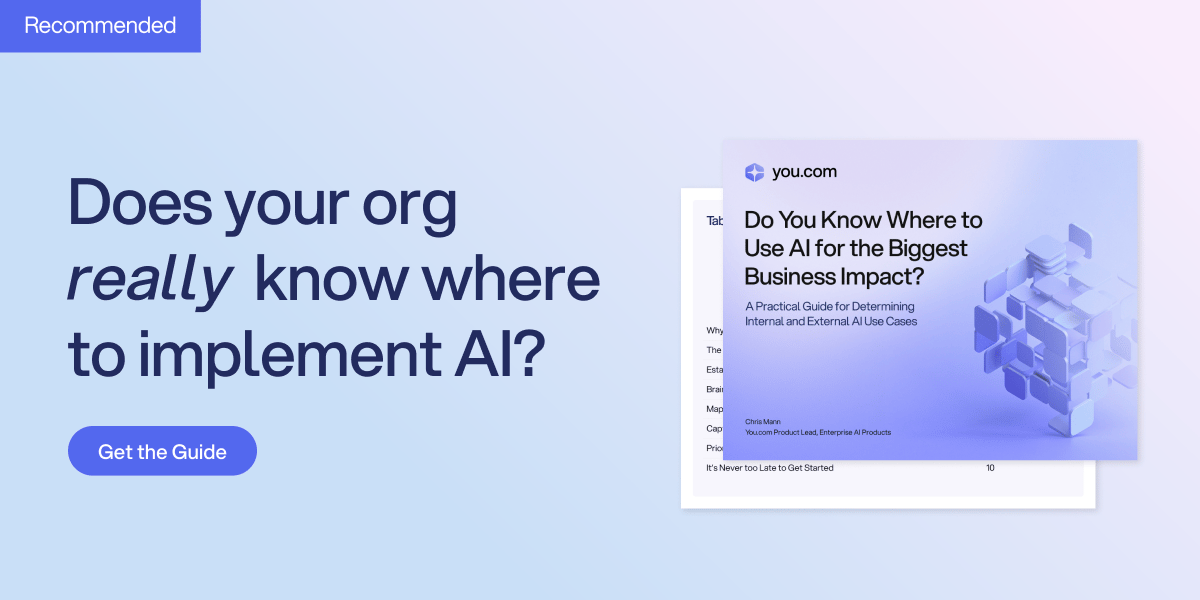
Successful AI transformation starts with deeply understanding your organization’s most critical use cases. We recommend this practical guide from You.com that walks through a proven framework to identify, prioritize, and document high-value AI opportunities.
In this AI Use Case Discovery Guide, you’ll learn how to:
Map internal workflows and customer journeys to pinpoint where AI can drive measurable ROI
Ask the right questions when it comes to AI use cases
Align cross-functional teams and stakeholders for a unified, scalable approach
END OF ADVERTISEMENT
Government plans to revoke a key finding saying greenhouse gases pose a threat

Lee Zeldin; Wants to reverse “endangerment finding”
The Trump administration’s EPA, led by Lee Zeldin, is reportedly planning to repeal the 2009 “endangerment finding,” which identified greenhouse gases as a threat to human health and welfare.
The landmark finding established the legal framework for federal regulation of pollutants like carbon dioxide and methane. According to The Wall Street Journal, the move could come as early as this week, but it’s likely to spark years of legal battles and a Supreme Court showdown.
Repealing the finding would initially focus on rolling back tailpipe emission regulations for cars and trucks but could pave the way to loosening restrictions for power plants and industrial facilities. Legacy automakers, who’ve previously supported weaker fuel efficiency standards, have notably avoided pushing for this repeal. Tesla $TSLA ( ▼ 1.29% ) , however, openly criticized the potential rollback, stating it was “based on a robust factual and scientific record.”
The administration claims the move will save over $1 trillion, though no evidence was provided. And of course, it’ll be tricky to spend that money if we’re all under water. Critics point to the economic risks of climate inaction. A 2024 study warned that global GDP could decline by 17% — a staggering $38 trillion annually — if climate change continues unchecked.
“Climate change is expected to cost far more,” notes a Congressional Budget Office report, which estimated $1 trillion in U.S. real estate risks from rising sea levels.
The first signs of burnout are coming from the people who embrace AI the most

For years, the promise of AI in the workplace has been a seductive one: Smarter tools would save us time, make us indispensable, and allow us to work less while achieving more. It turns out that was all B.S.!
New research shared in Harvard Business Review reveals a stark reality — AI might actually be fueling burnout rather than relieving it.
UC Berkeley researchers spent eight months studying a 200-person tech company that embraced AI across its workflow. Through more than 40 in-depth interviews, they discovered that employees weren’t explicitly pressured to achieve higher targets. Instead, the tools made more tasks feel manageable, leading workers to expand their to-do lists. Lunches were skipped, evenings stretched, and work crept into every free block of time. “You had thought…you can work less. But really, you don’t work less. You just work the same amount or even more,” one engineer confessed.
This problem isn’t isolated. On the forum Hacker News, one commenter echoed the sentiment: “Expectations have tripled, stress has tripled…productivity has only gone up by maybe 10%.”
The findings challenge the optimism AI advocates promote. While the tools can augment employee output, they’re also “leading to fatigue, burnout, and a growing sense that work is harder to step away from,” the researchers note.
As companies continue investing in AI, it’s worth reflecting on the unintended consequences. Perhaps the real question isn’t what AI can help us do but, instead, whether doing more is always worth it?
Should you check your 401(k) today?
👎️
No.
Poll of the day: Trying to keep up with that AI…
Poll results: Puppies!
We asked: What's better?
You answered:
🟨⬜️⬜️⬜️⬜️⬜️ ChatGPT (OpenAI) (75)
⬜️⬜️⬜️⬜️⬜️⬜️ Gemini (Google) (35)
⬜️⬜️⬜️⬜️⬜️⬜️ Claude (Anthropic) (14)
⬜️⬜️⬜️⬜️⬜️⬜️ My nephew who got a B in Algebra (42)
🟩🟩🟩🟩🟩🟩 Puppies (384)
⬜️⬜️⬜️⬜️⬜️⬜️ Intelligent slime molds (29)
579 Votes via @ polls
 | Want more Cheddar? Watch us!Search “Cheddar” on Samsung, YouTube TV, and most other streaming platforms. N2K is the tip of of the cheeseberg for financial news, interviews, and more. |
Need2Know is covered by Cheddar’s Terms of Service
P.S. So, you remember the cheese puns that used to open this newsletter? Suffice to say, they were divisive. Now, thanks to a thing called “dynamic content options,” I can offer you the option to see cheese puns again, if you’re one of the thousands who got in touch bemoaning their departure six months ago. All you need to do is answer “true” on this survey, and submit it. If you never want to see cheese puns in this newsletter again, don’t click that link, don’t fill out the survey, don’t submit it. Just keep reading and pretend this conversation never happened. Mmmkay? Thank you.