- Need2Know, by Cheddar
- Posts
- Why you should totally give a robot all your medical data
Why you should totally give a robot all your medical data
Plus: Spotify finally figures out how to stop your kid's music messing with your Wrapped

Matt Davis
March 16, 2026
In partnership with

Happy Monday, N2K reader!
Joan Benson won last week’s world-famous news haiku competition™ with this beauty about cows (live cattle prices) beating the stock market over the last five years:
While cows chew their cud,
stocks will rise and fall again.
Steady, the cows mooove
I got in touch with Joan to ask her how she feels about winning yet again but her agent told me to join the queue. Joke. She said “I’m very honored. This was an especially fine batch of haikus. I am humbled and moooved. Thank you.”
Well done, Joan! 🐮
And here’s how you voted on the competition:
🟩🟩🟩🟩🟩🟩 While cows chew their cud, stocks will rise and fall again. Steady, the cows mooove ~Joan Benson (151)
🟨🟨⬜️⬜️⬜️⬜️ Animals best tech, health, utility, the lot. Nature wins again. ~Nomis Balder (56)
🟨🟨⬜️⬜️⬜️⬜️ As cow jumps the moon, She says, "Standard and Poors? Nope. "All hat, no cattle." ~Scott Bauer (65)
🟨🟨🟨⬜️⬜️⬜️ We love to eat beef, Even more than we like money. How American. ~Sam Sigelakis-Minski (92)
🟨🟨🟨🟨⬜️⬜️ Moo moo moo moo moo, Moo moo moo moo moo moo moo, Moo moo moo moo moo ~Remy Zane (110)
474 Votes via @beehiiv polls
Slightly embittered haiku writer Lodro Rinzler also got in touch to say he thought his haiku was better than Remy Zane’s:
With all due respect, I believe the submission I offered may have been better than, "Moo moo moo moo moo, Moo moo moo moo moo moo moo, Moo moo moo moo moo."
If this is a fair and impartial process of selection and you believe my submission is not as good as the one above, fine. But it is hard to believe, and as a past winner whose work has not been put up for voting for months, I am suspicious.
I told Suspicious Lodro™ that I liked Remy’s surrealism better. But you be the judge:
Which of these haikus is better? |
This week’s world-famous news haiku competition™ is about how you should totally give all your medical data to a robot. Send me your entry — to haiku at cheddar dot com — by noon ET Thursday, for consideration by your Cheddar peers.
And now for some news you really N2K…
Matt Davis — Need2Know Chedditor
News You Need2Know
What’s the stock market up to, eh?*
Companies mentioned in today’s newsletter
$MSFT ( ▲ 1.54% ) $AMZN ( ▲ 0.44% ) $NFLX ( ▼ 2.96% )$SAVEQ ( ▲ 0.43% ) $UAL ( ▲ 2.82% )$DAL ( ▲ 3.1% )
Why you should totally give a robot all your medical data
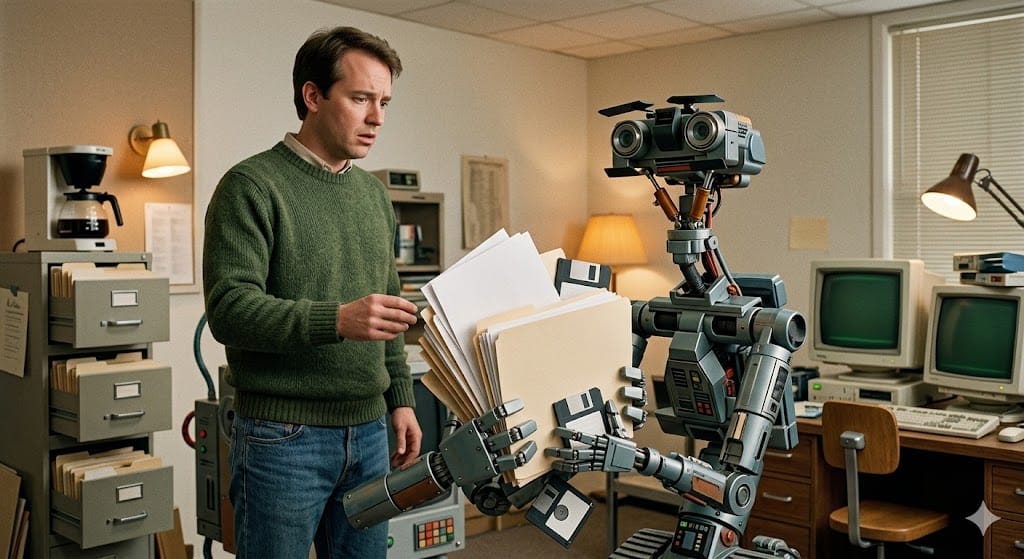
Satirical AI image of you handing Johnny 5 all your health data, created by your Chedditor in Google’s Nano Banana Pro
Look, I get it. You've already let tech companies track your location, read your emails, and listen to your late-night kitchen conversations through your smart speaker. But have you considered that they don't yet have access to that embarrassing rash you asked your doctor about in 2019? How will the algorithm truly know you without it?
Great news: Microsoft $MSFT ( ▲ 1.54% ) is here to help, with a shiny new tool that lets you share health records from multiple providers with Copilot, its AI chatbot. You can even throw in data from your Apple Watch, Fitbit, or Oura ring.
After digesting all this intimate information, the chatbot will provide "a high-level overview of health issues."
Microsoft isn't alone in this quest for your medical secrets. Amazon $AMZN ( ▲ 0.44% ) , OpenAI, and Anthropic have all launched similar tools this year — Health AI, ChatGPT Health, and Claude for Healthcare, respectively. Yes, the same AI chatbots that have made headlines for contributing to some users' psychosis, isolation and unhealthy habits now want to be your wellness buddies. What could go wrong?
To be fair, physicians interviewed by the New York Times acknowledged "there might be upsides to chatbot-assisted health care, like helping people gain insight into their health at a time when health care is becoming increasingly unaffordable."
But — and it's a big but — "sharing health records with tech companies creates a host of privacy risks." Your health data isn't like your Netflix $NFLX ( ▼ 2.96% ) history. It's the kind of information that, in the wrong hands, could affect your insurance, employment, or basic dignity (not that you’ll have much of that left if you’ve had to navigate the American health care system for the last few years).
Doctors also warned that "like past technologies that made people overly anxious about their health, the chatbots could also lead to unnecessary trips to the doctor."
Should you hand over your most sensitive personal information to a chatbot made by companies currently being sued for scraping content without permission? (The New York Times, in fact, has sued OpenAI and Microsoft, claiming copyright infringement of news content related to AI systems. #Ironies)
Maybe tread carefully? Or don't. I'm sure the robot knows best.
Spotify finally figures out how to stop your kid's music messing with your Wrapped
We've all been there. December rolls around, and you eagerly open your Spotify Wrapped to discover you're apparently obsessed with "Baby Shark" and the Paw Patrol soundtrack. Thanks, kids.
For years, parents have begged Spotify $SPOT ( ▼ 2.03% ) to fix this problem — and the streaming giant has finally listened.
At SXSW on Friday, Spotify co-CEO Gustav Söderström announced a new feature letting users review and edit their Taste Profile for the first time. This algorithmically generated model powers everything from Discover Weekly to those year-end Wrapped results that you definitely don't want to share on Instagram when they're dominated by Cocomelon.
Starting with Premium users in New Zealand (why?!) listeners can now see all their data— music, podcasts, audiobooks — in one place and actually do something about it. Using natural language prompts, you can fine-tune recommendations by asking for "more of this vibe" or "way less of that."
Previously, Spotify only let you exclude specific tracks or playlists. Perhaps your 2026 Wrapped might actually be yours.
Quote of the Day
"It's more about the safety of the crews rather than taking on insurance for damages."
Gulf shipping insurance plan hits choppy waters
If you were on Twitter this weekend I hope you enjoyed the rash of “can this be a solution?” memes, of which you can see just one above. Meanwhile, President Trump's $20-billion plan to insure ships passing through the Strait of Hormuz sounded straightforward: Offer affordable political risk insurance, back it with Navy escorts, and get oil flowing again. Reality, as usual, had other ideas.
The main problem is that it’s quite difficult to insure ships in a war zone. Maritime war risk policies are sold mostly through Lloyd's of London, with foreign insurers covering foreign ships.
"There's a whole ecosystem around war risks," said David Smith, head of marine at insurance broker McGill and Partners, talking with the Wall Street Journal. "It's very rare that U.S. insurers position themselves anywhere near that particular ecosystem."
U.S. officials reportedly called London insurers trying to understand how the market actually works and asked for confidential data that participants were reluctant to share.
After industry pushback, the administration pivoted Friday to offering reinsurance instead, with Chubb fronting the program. Coverage will now be limited to ships meeting unspecified criteria.
"There's very little tangible information about any of the practicalities," Smith noted.
But here's the real kicker: insurance isn't actually the problem. "It's more about the safety of the crews rather than taking on insurance for damages," said Jerry Kalogiratos, CEO of Capital Clean Energy Carriers. It turns out ships just aren't willing to risk Iranian attacks, no matter the insurance coverage.
The sticker shock for spring travel is upon us

This lady wanted to fly to JFK from Dulles. Satirical AI image created by your Chedditor in Google’s Nano Banana Pro
If you've been putting off booking your spring getaway, your wallet might be in for a rude awakening. The [checks notes] war with Iran is sending airfares soaring, with trans-Atlantic, Caribbean, and transcontinental routes seeing the steepest increases, according to a new Deutsche Bank report. Among domestic flights booked 21 days in advance, Spirit Airlines $SAVEQ ( ▲ 0.43% ) saw one-way fares more than double in a single week to $193. Major carriers like United $UAL ( ▲ 2.82% ) and Delta $DAL ( ▲ 3.1% ) raised prices between 15% and 57%.
The culprit? Surging jet fuel costs that airlines are passing directly to passengers.
"When it goes up this rapidly, airfares go up," United CEO Scott Kirby told the Wall Street Journal. "They also come down, by the way, when fuel goes back down. That's always what happens."
Some travelers saw it coming. Sam Alexander, a venture capitalist, locked in flights for the entire year immediately after the conflict began. Two days after booking his Hawaii trip, prices jumped $400. "I'm thankful that I locked in my tickets at a good price just a few days after the war began," he said.
Airlines are walking a tightrope. "Airlines know that if they push fares too high, they lose more sales than they gain," noted Henry Harteveldt of Atmosphere Research Group.
Demand remains surprisingly resilient. United just had its biggest booking day ever by revenue last Tuesday.
Song of the Day: Kacey Musgraves, ‘Dry Spell’
There’s no way a singer like Kacey Musgraves should be singing a song about being “lonely with a capital H, if you know what I mean,” but there it is. And there she is. The tragedy.
Free yourself from advertising forever!
Now you can sign up for an optional ad-free version of Need2Know! Subscribe for just $5 a month, or $50 a year, and you can continue to enjoy this reasonably high-quality newsletter uninterrupted. Bonus: The immense satisfaction that comes from supporting journalism*!
*This counts as journalism, right?
ADVERTISEMENT
The $4 Billion Problem Hiding in Nearly Every Fast-Food Location

You show up to your favorite fast-food restaurant for a quick meal. But the line is too long, and you’re starving. So you bail.
You’re not alone. 93% of monthly fast-food visitors in America say their top frustration is long lines. And while you miss out on chicken nuggets and fries, restaurant owners lose significant revenue they can’t afford to miss.
So brands like White Castle use Miso Robotics’ AI-powered kitchen restaurant robots to run their fry stations, keeping kitchen operations smooth, workers safe, and customers happy.
Aided by a collaboration with NVIDIA, Miso’s AI-powered Flippy Fry Station robot works 2X faster than average fry cooks. That means operators serve more customers and unlock up to 3X more profits per location. And that means much shorter lines for you.
This is a paid advertisement for Miso Robotics’ Regulation A offering. Please read the offering circular at invest.misorobotics.com.
END OF ADVERTISEMENT
Leave your money in the stock market
With the Iran war rattling global markets and oil prices spiking toward $120 per barrel, it's tempting to panic-sell your investments. History suggests that's probably a mistake.
The S&P 500 sits just 4.4% below its all-time January high, but it certainly doesn't feel that way. Gut-wrenching swings have become the norm — the Dow plunging 900 points some mornings only to recover by day's end — yet financial experts are urging calm.
"Although volatility may feel uncomfortable, could rise from here, and possibly cause a near-term drawdown in stocks, volatility in itself tends to be brief when it reaches more extreme levels," said Anthony Saglimbene, chief market strategist at Ameriprise, talking to Stan Choe at the Associated Press. "And, more often than not, the extreme volatility provides investors with a solid long-term entry point to buy stocks rather than sell."
The S&P 500 experiences 10% drops roughly once a year, so regularly that professionals simply call them "corrections." Timing your exit and re-entry is notoriously difficult, and some of the market's best days historically cluster right alongside its worst.
For younger investors, these dips are essentially stocks going on sale. For retirees, consider trimming withdrawals rather than liquidating. How long will volatility last? No one knows — and don't trust anyone who claims otherwise. #NotFinancialAdvice
Should you check your 401(k) today?
👎️
Absolutely not.
Poll of the day: Dr. Robot 🤖
Where do you stand on giving Microsoft's Copilot your health data? |
 | Want more Cheddar? Watch us!Search “Cheddar” on Samsung, YouTube TV, and most other streaming platforms. N2K is the tip of of the cheeseberg for financial news, interviews, and more. |
Need2Know is covered by Cheddar’s Terms of Service
P.S. So, you remember the cheese puns that used to open this newsletter? Suffice to say, they were divisive. Now, thanks to a thing called “dynamic content options,” I can offer you the option to see cheese puns again, if you’re one of the thousands who got in touch bemoaning their departure six months ago. All you need to do is answer “true” on this survey, and submit it. If you never want to see cheese puns in this newsletter again, don’t click that link, don’t fill out the survey, don’t submit it. Just keep reading and pretend this conversation never happened. Mmmkay? Thank you.